ARCHIVES Introduction


Archives of Western Palearctic Lepidoptera

Research on Western Palearctic Lepidoptera


Contact


Introduction Papilionoidea Papilionidae Hesperiidae Pieridae   Riodinidae Lycaenidae Nymphalidae Sources Thx
 

  Welcome  

Lépidoptères - Revue des lépidoptéristes de France. 2024 33(84): 18-21

A dynamic checklist of the Western Palearctic butterflies,
hyperlinked to the original descriptions at species, genus and family level (Lepidoptera, Papilionoidea).

Michel Taymans1* & Sylvain Cuvelier2
1* Clos du Moulin Royal 2 bte 02, B-6900 Marche-en-Famenne, Belgium.
2 Diamantstraat 4, B-8900 Ieper, Belgium.
*Corresponding author: michel.taymans@hotmail.com

Introduction
Numerous synonymous checklists or catalogs have been published for various countries or a more or less extensive region. These generally include a detailed list of species, in the genus/species binary format, followed by the name of the author and the date of publication. There are often more or less significant discrepancies among checklists. These differences are sometimes due to typing errors during editing but more often, they are the result of the taxonomic views of the authors. In the absence of an unanimously accepted list, professional or amateur lepidopterists have no clear guidelines regarding which reference to use in their work.
In this context, it seemed useful to establish an exhaustive list containing the complete taxonomic references of all butterfly (Papilionoidea) species from the Western Palearctic. This list is published as an internet webpage. This choice was dictated by the technical possibility to include links leading the reader with a simple click to pages related to the original description of the taxa. This will allow users to verify the components of the taxon and have direct access to the original text.
Each species has been placed in the different levels of the zoological classification from order to subgenus, including superfamily, family, subfamily, tribe, subtribe and genus and including the author, the year, the original combination, the type locality, the reference of the original publication and the Internet link(s). This project thus completes three recently published lists, which lacked links to the original descriptions of species or type localities. These are:
(i) an updated checklist for European butterflies (Wiemers et al. 2018)
(ii) a new comprehensive trait database for Europeand and Maghreb butterflies, Papilionoidea. (Middleton-Welling et al. 2020)
(iii) the Atlas of mitochondrial genetic diversity for Western Palearctic butterflies (Dapporto et al. 2022) which also deal with systematics.
Despite the objective efforts to develop the most reliable list possible, one must be aware that certain choices linked to the taxon, the author's references, the year of publication or its place in the classification may be subject of debate and revision. The authors therefore hope that the list will trigger numerous constructive criticisms in order to produce a list that generates the highest possible consensus among the lepidopterist´s community and it is therefore a useful tool. On the other hand, in recent years a number of new species have been described, often as a result of in-depth phylogenetic studies, based on molecular analyses. And it is also very likely that the validity or status of certain species will be reviewed when the techniques and methods of investigation are refined. It is therefore planned that the website will be updated regularly according to feedback, comments and new scientific publications.

Which region is treated?
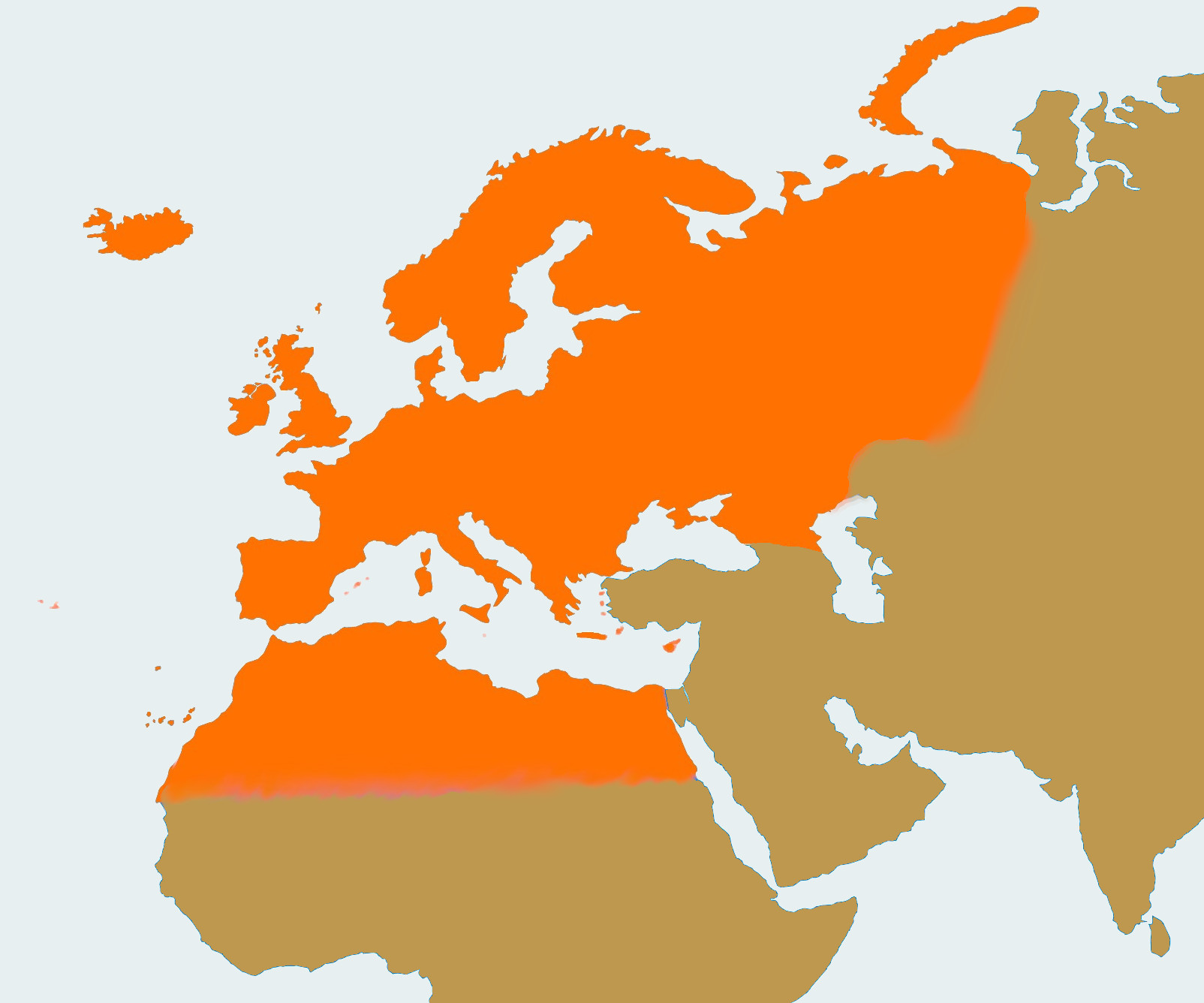
The geographical area covered (Fig. 1) includes Europe, northern Macaronesia (the archipelagos of the Azores, Madeira and the Canary Islands) and the Palearctic zone of North Africa delimited to the south by the northern Sahel and to the east by the Suez Canal.


Fig. 1. Map of the geographical area covered (© Michel Taymans)

AHowever, the eastern limit of Europe (Urals and Caucasus) is often subject to discussion. For practical reasons, it was opted for political and not geographical boundaries. The eastern border of Europe taken into consideration is the eastern border of the following districts of the Russian Federation: to the east, the North-West Federal District (Северо-Западный федеральный округ) and the Volga Federal District (Приволжский федеральный округ); to the southeast, the Southern Federal District (Южный федеральный округ) and the North Caucasus Federal District (Северо-КавкаЗский федеральный округ), therefore excluding any part of Kazakhstan.
Concerning the islands of the Mediterranean Sea, for reasons of continuity with the aforementioned lists, we have included all the islands belonging to a state forming part of the European Union and therefore, all the Greek islands and the island of Cyprus, some of which are geographically located in Asia.
The conclusion of two recent publications, Lukhtanov & Zakharov (2023) and Jospin et al. (2023), that were published since Dapporto et al. (2022) entail the inclusion of three European species: Driopa turatii (Fruhstorfer, 1908), Erebia bubastis (Meisner, 1818) and Erebia vogesiaca Christ, 1882. Compared to the list published by Dapporto et al. (2022) which was not dealing with exactly the same area, also the following Caucasian and North African species are additionally added in the current list (Table 1).

Table 1. Species covered in the current list and misisng in Dapporto et al. (2022).

Caucasian species


Driopa nordmanni ([Ménétriès], [1850])

Boloria caucasica (Lederer, 1853)

Colias chlorocoma Christoph, 1888

Thaleropis ionia (Eversmann, 1851)

Colias thisoa Ménétriès, 1832

Euphydryas discordia Korb & Bolshakov, 2013

Satyrium abdominalis (Gerhard, [1850])

Melitaea caucasogenita Verity, 1930

Turanana mystica Morgun & Tikhonov, 2010

Pseudochazara alpina (Staudinger, 1878)

Aricia teberdina (Sheljuzhko, 1934)

Pseudochazara daghestana (Holik, 1955)

Kretania stekolnikovi Stradomsky & Tikhonov, 2015

Pseudochazara pelopea (Klug, 1832)

Polyommatus australorossicus Lukhtanov & Dantchenko, 2017

Erebia melancholica Herrich-Schäffer, [1846]

Polyommatus dagestanica (Forster, 1960)

Erebia iranica Grum-Grshimailo, 1895

Polyommatus cyanea (Staudinger, 1899)

Erebia graucasica Jachontov, 1909


European species


Driopa turatii (Fruhstorfer, 1908)

Erebia bubastis (Meisner, 1818)

Erebia vogesiaca Christ, 1882

Papilio demoleus Linnaeus, 1758


North African species


Colotis danae (Fabricius, 1775)

Belenois aurota (Fabricius, 1793)

Colotis fausta (Olivier, [1804])

Junonia hierta (Fabricius, 1798)

Colotis phisadia (Godart, 1819)


Which species were included in the list?

The species concept is a controversial subject, still much debated by biologists. One of the most widely used species concepts is the so-called biological species concept, according to which “species are groups of actually or potentially interbreeding natural populations, which are reproductively isolated from other such groups” (Mayr 1942).
But reproductive isolation can only be observed among sympatric populations while in allopatry the degree of reproductive isolation is difficult to verify.
As a result, the specific criteria are practically difficult to verify. Throughout history, depending on the evolution of new research techniques biologists have used different methods to distinguish species. Differences in external morphology (e.g., wing patterns, colours, veins, palps, antennae etc.) or internal parts (genitalia, exoskeleton etc.), of the biological cycle (eggs, caterpillars, chrysalises, phenology etc.), characters that presumably represent premating barriers (e.g. androconia and pheromones), ecology (behaviour, food plants, type of biotope etc.) are all study components used by scientists to correlate the degree of kinship between individuals.
These different methods have their limitations for example because their interpretation is not always straightforward in relation to speciation, or because certain similarities between organisms cannot be attributed to a common ancestry but are due to a phenotypic adaptive factor of the species.
For around thirty years, researchers have had the possibility of conducting studies on the molecular biology of species.
The evolution of techniques has been rapid, starting first with the study of allozymes followed by mitochondrial and nuclear DNA markers (Sanger sequencing).
In recent years, new techniques have made it increasingly possible to study thousands of markers (e.g. double digest RAD sequencing - ddRAD, Peterson et al. 2012; ultraconserved elements - UCEs, Faircloth et al. 2012; anchored hybrid enrichment - AHE, Lemmon et al. 2012), including on old specimens with degraded quality (e.g. hybridization sequencing - hyRAD (Suchan et al. 2016) and even to obtain, for several species, the complete genome.
An ambitious project (Psyche, https://projectpsyche.org/) is underway to generate and analyze chromosome level genomes for the majority of European Lepidoptera, thus opening unprecedented opportunities to study speciation and boundaries between species.
The conclusions of recent molecular studies were therefore taken as a priority to determine the species to include in the list.
For cases lacking such a study, the list is based on the most recent traditional studies.
When a significant structural difference in the male genitalia of a group exists, certain species are also placed in a genus other than that listed in Wiemers et al. (2018), Middleton-Welling et al. (2020) and Dapporto et al. (2022).
Furthermore, the aforementioned publication also do not take into account the conclusions of the study by Zhang et al. (2020) on the Carcharodini Below (Table 2) are listed the species affected by a change in genus compared to the list of Dapporto et al. (2022).

Table 2. Comparison of differences in genera between the current checklist and Dapporto et al. (2022).

Actual genus

Genus in Dapporto et al. 2022

Driopa mnemosyne (Linnaeus, 1758)

Parnassius mnemosyne (Linnaeus, 1758)

Allancastria cerisyi (Godart, 1823)

Zerynthia cerisy (Godart, 1823)

Allancastria cretica (Rebel, 1904)

Zerynthia cretica (Rebel, 1904)

Allancastria caucasica (Lederer, 1864)

Zerynthia caucasica (Lederer, 1864)

Favria cribrellum (Eversmann, 1841)

Muschampia cribrellum (Eversmann, 1841)

Muschampia floccifera (Zeller, 1847)

Carcharodus floccifera (Zeller, 1847)

Muschampia orientalis (Reverdin, 1913)

Carcharodus orientalis Reverdin, 1913

Muschampia stauderi (Reverdin, 1913)

Carcharodus stauderi Reverdin, 1913

Muschampia baetica (Rambur, [1839])

Carcharodus baeticus (Rambur, 1839)

Muschampia lavatherae (Esper, [1783])

Carcharodus lavatherae (Esper, [1783])


How were the taxonomically valid species determined?

Systematics and taxonomy play an essential role in using the unique valid binomial, determined by the application of the rules provided in the International Code of Zoological Nomenclature, to designate a particular species and to include it in the classification at higher nomenclatural levels. This work therefore began with the establishment of lists of synonymies by species by consulting the different available databases and the original descriptions of most taxa. The rules of the Code then determined which valid taxon name had priority. The original form of this taxon is included (binominal combination and taxonomic status, possibly corrected by application of the Code) after each species in the list, under the heading «ORIG».
However, several dilemmas remained and choices had to be made for one or the other option. Here is a brief summary of them:
- When the original spelling of the taxon is incorrect according to the provisions of the Code (for example if it contains a diacritic sign or a ligature), it is the spelling corrected in accordance with the directives of the Code which is mentioned in the ORIG.
- When the taxon was initially described in one genus and it was subsequently placed in another genus, the Code (Art. 31.2) provides that the species name (the epithet) must be given in grammatical gender (Latin) to the gender name with which it is combined. (Example: The original name "Polyommatus ottomanus Lefebvre, 1831" was described in the genus Polyommatus (Latin masculine gender) and is currently placed, depending on the author, either in the genus Lycaena (Latin feminine gender), or in the genus Heodes (Latin masculine gender). If we follow the guidelines of the Code, this species should therefore be spelled, in the first case, "Lycaena ottomana", and in the second case, "Heodes ottomanus").
For reasons of name stability, we do not follow this directive of the Code and therefore always spell the species name in its initial form. We therefore follow the opinion of Nieukerken et al. (2019).
- When the author's name is preceded or followed by a particle written in lowercase such as "von", "de" or "van der", most recent checklists do not include it. This principle has been adopted.
- When the date of a publication is not that shown on the title page of a work or when an issue of a journal was not distributed in the year corresponding to the volume, it was included between hooks. Indeed, most of the old works were published in fascicles distributed at variable dates and subsequently grouped together to make a volume.
- Johann Centurius von Hoffmannsegg was an entomologist born in 1766 and deceased in 1849. In one of his publications, dated 1804, the author's name was spelled with a single 'n', i.e. "Hoffmansegg". It is for this reason that we have included it in the list as follows: «Hoffman[n]segg».We believe that scientific publications should be free from commercial constraints and remain fully open, without embargoes, for both authors and readers. There are no subscription fees, and publishing is entirely free of charge. Contributions to support IT hosting and maintenance are warmly welcomed.

How was the type locality of a species determined?
According to the definition given in the Code, the type locality is the location of capture, harvest or observation of the holotype.
Unfortunately, it was not possible to consult the types of each species.

The basis is the locality included in the original description of the taxon and we have included it after each species in the list under the heading «TL».
Any interpretations are placed in square brackets.
In order to improve this data, the authors will try to have access to the information on the types and will update this data in future editions of the list.

Acknowledgements
We thank Peter Russell, Vlad Dincă, Roger Vila and Luc Manil for their varied contributions that were essential for the development of this introduction to the checklist.

References

Dapporto L., Menchetti M., Vodă R., Corbella C., Cuvelier S., Djemadi I., Gascoigne-Pees M., Hinojosa J., Lam N., Serracanta M., Talavera G., Dincă V. & Vila. R. – The Atlas of mitochondrial diversity of Western Palearctic butterflies. Appendix S1. – Global Ecology and Biogeography 2022, 00, 1-7.
https://onlinelibrary.wiley.com/action/downloadSupplement?doi=10.1111%2Fgeb.13579&file=geb13579-sup-0001-AppendixS1.pdf

Faircloth B., McCormack J., Crawford N., Harvey M., Brumfield R. & Glenn T. – Ultraconserved elements anchor thousands of genetic markers spanning multiple evolutionary timescales. – Systematic Biology 2012, 61, 717-726.
https://doi.org/10.1093/sysbio/sys004

Jospin A., Chittaro Y., Bolt D., Demergès D., Gurcel K., Hensle J., Sanchez A., Praz C. & Lucek K. – Genomic evidence for three distinct species in the Erebia manto complex in Central Europe (Lepidoptera, Nymphalidae). – Conservation Genetics 2023, 24: 293-304.
http://dx.doi.org/10.1007/s10592-023-01501-w


Lemmon A., Emme S. & Lemmon E. Anchored hybrid enrichment for massively high-throughput phylogenomics. Systematic Biology 2012, 61, 727-744.
https://doi.org/10.1093/sysbio/sys049

Lukhtanov V. & Zakharov E.– Taxonomic Structure and Wing Pattern Evolution in the Parnassius mnemosyne Species Complex (Lepidoptera, Papilionidae). – Insects 2023, 14(12), 942.
https://doi.org/10.3390/insects14120942

Mayr E. – Systematics and the Origin of Species. Columbia Univ. Press, New York, 334 p., 1942.

Middleton-Welling J., Dapporto L., García-Barros E., Wiemers M., Nowicki P., Plazio E., Bonelli S., Zaccagno M., Šašić M., Liparova J., Schweiger O., Harpke A., Musche M., Settele J., Schmucki R. & Shreeve T. – A new comprehensive trait database of European and Maghreb butterflies, Papilionoidea.–Scientific Data 2020, 7(351): 1-10.
https://doi.org/10.1038/s41597-020-00697-7

Peterson B., Weber J., Kay E., Fisher H. & Hoekstra H. – Double Digest RADseq: An Inexpensive Method for De Novo SNP Discovery and Genotyping in Model and Non-Model Species. – PLoS One 2012, 7(5): e37135.
https://doi.org/10.1371/journal.pone.0037135

Suchan T., Pitteloud C., Gerasimova N., Kostikova A., Schmid S. et al.– Hybridization Capture Using RAD Probes (hyRAD), a New Tool for Performing Genomic Analyses on Collection Specimens. – PLoS One 2016, 11: e0151651.
https://doi.org/10.1371/journal.pone.0151651

van Nieukerken E., Karsholt O., Hausmann A., Holloway J., Huemer P., Kitching I., Nuss M., Pohl G., Rajaei H., Rennwald E., Rodeland J., Rougerie R., Scloble M., Sinev S. & Sommerer M. – Stability in Lepidoptera names is not served by reversal to gender agreement: a response to Wiemers et al. (2018) – Nota Lepidopterologica 2019, 42(1): 101-111.
DOI 10.3897/nl.42.34187

Wiemers M., Balletto E., Dincă V., Fric Z., Lamas G., Lukhtanov V., Munguira M., van Swaay C., Vila R., Vliegenthart A., Wahlberg N. & Verovnik R. – An updated checklist of the European Butterflies (Lepidoptera, Papilionoidea) – ZooKeys 2018, 811: 9-45.
https://zookeys.pensoft.net/article/28712/

Zhang J., Brockmann E., Cong Q. Shen J. & Grishin N. – A genomic perspective on the taxonomy of the subtribe Carcharodina (Lepidoptera: Hesperiidae: Carcharodini). – Zootaxa 2020, 4748(1): 182-194.
https://doi.org/10.11646/zootaxa.4748.1.10

International Code of Zoological Nomenclature. Fourth edition. The International Trust for Zoological Nomenclature, London, UK. 1999.
https://www.iczn.org/the-code/the-code-online/ (consulted 3 December 2023)


  AWPL Open Access Journal    
       
  About AWPL    
  For Authors    
  Formatting guidelines    
  Current Issue    
  All Issues    
  All Articles    
     
  Systematics    
     
  Introduction    
  Latest Published Checklist    
  Dynamic Checklist of the Western Palearctic Papilionoidea    
  Sources    
     
  Resources & Credits    
       
  Recent literature    
  Acknowledgements    
  Michel Taymans    
  Sylvain Cuvelier    


Archives of Western Palearctic Lepidoptera
Editors-in-Chief: Michel Taymans & Sylvain Cuvelier