Book review
John G. Coutsis & Vadim V. Tshikolovets. 2025.
Holarctic butterflies of the subtribe Polyommatina (Lepidoptera: Lycaenidae) and their genitalia.
Tshikolovets Publications. Pardubice. Czech Republic. 368 p.
ISBN: 978-80-907089-6-9
Submitted: 24.iii.2026 | Accepted: 25.iii.2026 | Published online: 30.iii.2026.
DOI: 10.5281/zenodo.18986303
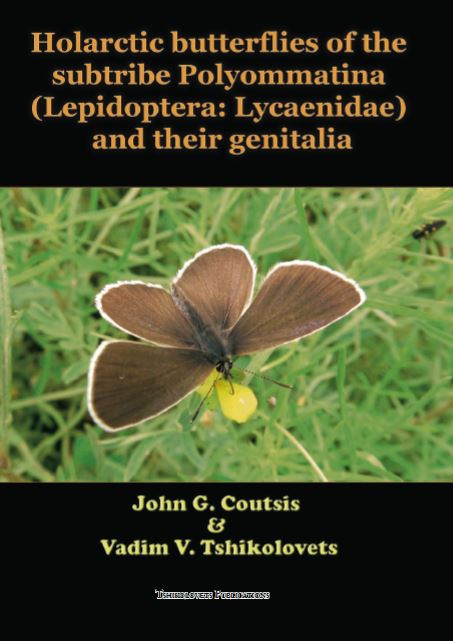
Selected pages from the monograph, kindly supplied by the Editor.
Few studies provide detailed genital morphology for Polyommatina, usually covering only a limited set of species. While the current monograph partially fills this gap, a global synthesis for the subtribe still remains.
The title of this book, issued by the same publisher, recalls an earlier publication with a similar emphasis on male genital morphology in butterfly taxonomy:
Harry van Oorschot & John G. Coutsis. 2014. The genus Melitaea Fabricius, 1807. Taxonomy and systematics with special reference to the male genitalia (Lepidoptera: Nymphalidae, Nymphalinae)
Tshikolovets Publications. Pardubice. Czech Republic. ISBN: 978-80-904900-4-8.
Readers familiar with that well-known work will inevitably be inclined to compare the present volume with this standard reference on the genus Melitaea.
Estimates of species richness in the Holarctic subtribe Polyommatina vary considerably depending on the taxonomic framework applied. Under moderate, synthesis-based treatments, total diversity is generally placed at around 380–420 species, whereas more expansive approaches raise this figure to approximately 470. This variation underscores that the taxonomy of the group remains far from stable. Much of the discrepancy arises from differing species concepts, particularly the use of the karyological species concept, which treats reproductively isolated chromosomal lineages as distinct species. The impact of this approach is especially marked within the subgenus Agrodiaetus (genus Polyommatus), where extensive chromosomal diversification has led to a proliferation of narrowly defined taxa.
This monograph treats 308 taxa and, in line with many of the first author’s previous works, presents scientifically accurate yet highly artistic drawings of genitalia at an appropriate magnification, complete with scale bars, enabling important structural details to be distinguished and interpreted.
The taxa are arranged in 57 groups based on the authors’ own subjective classifications of male genitalia. Due to time constraints during publication, the figures of these groups are distributed between the initial study and subsequent addenda, which complicates assembling the information in a comprehensive manner. The plates for the different groups are not uniformly organised, which can complicate direct visual comparisons between groups.
A limited number of female genitalia are also illustrated, restricted to one component, and the groups are defined solely on the basis of male genitalia. The inclusion of more female material would have strengthened the work, as female genital characters are frequently underrepresented in historical entomological studies and might offer valuable insights for taxonomic assessment.
In an era when taxonomy is increasingly shaped by DNA-based methods, a book devoted to the comparative study of butterfly genitalia may appear somewhat traditional. Molecular data have profoundly influenced systematics and the reconstruction of evolutionary relationships. Yet morphological characters remain useful for the identification and interpretation of biodiversity.
By presenting a detailed examination of male genital morphology within the Polyommatina subtribe, the book highlights the continuing relevance of careful morphological study in taxonomic research.
By focusing on genital structures, the authors follow a well-established practice in lepidopteran taxonomy, where such characters help to distinguish closely related taxa. However, the book neither incorporates genetic data nor considers the modern taxonomic frameworks and nomenclature that have arisen from molecular studies. Consequently, its results will need to be considered alongside modern DNA-based studies to place the findings in a broader systematic context.
Many of the genital differences highlighted in the book are based on single specimens per taxon and are described in qualitative terms rather than quantified through morphometric comparison with closely related taxa. The illustrations provide limited three-dimensional perspective, making it difficult to assess overall morphological variation.
Classical entomology often based taxonomic decisions on single specimen dissections, under the assumption that genitalia exhibited little variation. However, studies that examined multiple specimens per taxon, such as the aforementioned work on Melitaea, have shown that intraspecific variability can be considerable. In the present monograph on Polyommatina, this reliance on single specimens per taxon leaves it unclear how representative the characters are across each taxon’s full range and complicates the assessment of their taxonomic status. Moreover, it remains uncertain whether any of these small differences correspond to reproductive isolation or constitute functional mating barriers.
All dissected specimens are illustrated across 38 colour plates at varying magnifications, with complete label data provided. The dorsal side of each specimen’s wings is shown on the left, and the ventral side on the right. However, all images are presented at the same size and without a scale bar, which makes it difficult to appreciate differences in wingspan.
In conclusion, the genitalia plates are of outstanding quality and will serve as a useful foundation for future, detailed studies of the Polyommatina subtribe. However, many described taxa are not included, and intraspecific variation of all the selected taxa still requires thorough investigation. The monograph does not consider recent taxonomic compilations that integrate molecular data, which could make its use less straightforward for current research.
In comparison with the Melitaea monograph, this work is somewhat less comprehensive, largely because it does not include all described taxa, does not incorporate all available data (including any molecular evidence), and does not propose taxonomic recommendations. It nevertheless represents a valuable and meticulously illustrated resource for further research.
We cannot conclude these lines without congratulating the authors for such meticulous work, and the publisher for continuing to produce such reference volumes, for the excellent printing of the text and the genitalia drawings.
|